
Technological Privilege, AI, & the Fourth Literacy in the Classroom

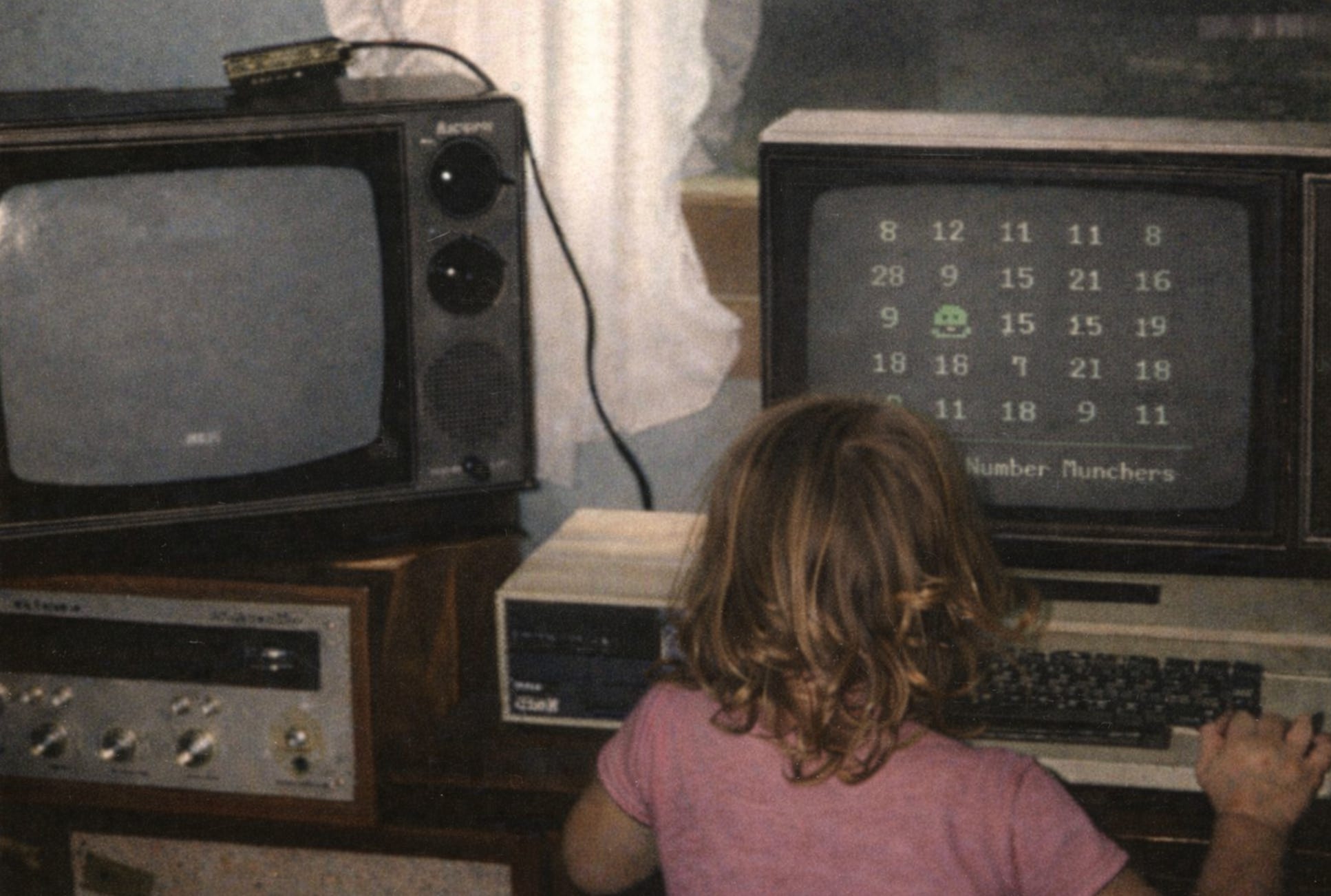
This is a picture of toddler me in the 1980s, rocking my Strawberry Shortcake tshirt while perched at a keyboard most adults still found intimidating. The glow is green and blocky, the machine bulky and beige, but what that photograph captures is more than nostalgia. It captures technological privilege.
In the collection What Education Becomes, edited by the incomparable Patrick Dempsey, I open my chapter, “The Fourth Literacy,” with this scene:
“I’m part of the Oregon Trail generation: an elderly millennial, or maybe an on the cusp Gen Xer. And because I’m firmly in middle age, it might surprise some of my peers that when I was growing up, there was always a computer in my house. My father finished his master’s in computer science in the early ‘80s and his doctorate a decade later, so when they brought me home from the hospital, there was an Apple computer with a floppy disk drive in our kitchen. One of my parents’ favorite stories involves toddler me at a computer expo. I made a beeline for a demo PC and was immediately scolded by the man running the booth: ‘Don’t touch the buttons, little girl!’ Apparently, I rolled my eyes and chided, ‘It’s called a keyboard.’”
This might might sound like a charming origin story. But when I reflect on this image now, my little hand on the keyboard, the eye roll, my early technological vocabulary, I see something deeper. I wasn’t just precocious; I was positioned.
“There was always a computer in my house.” That sentence means technology was never foreign to me. It means I did not have to climb over intimidation before curiosity could bloom. It means that when classmates encountered digital tools for the first time in our high school computer lab, I had already spent years absorbing how these systems respond.
I understood how files are stored, how machines behave, how to find online sources via dial up. So when AI arrived decades later, it did not feel like rupture. It just felt like continuation.
And here is the twist that matters: I grew up in a tech savvy household & then chose to major in English, eventually earning a doctorate, choosing Thackeray and Bronte and hours with my face buried in 800+ page paperbacks. I chose to immerse myself in nineteenth century anxieties about industrialization and print culture.
And in this moment of AI, I don’t feel like I’ve been hindered by that choice because my technological baseline was already established. I’ve never feared being left behind by machines as I’d grown up fluent in their presence.
Many of my students & colleagues do not share that backstory of technological privilege.
I have students who tell me that for most of their lives, the only “computer” in their home was a smartphone. No desktop in the kitchen or parent modeling file systems. No early practice time with how digital systems organize language.
When our AI conversations begin in the middle, when we assume shared fluency, we mistake uneven access for indifference. We start mid sentence.
This same pattern applies to our colleagues. Some of the most brilliant educators I know have dedicated their lives to nursing, chemistry, studio art, mathematics, history. They didn’t grown up with tech privilege like me, and they’ve already done the work of becoming technologically literate when the internet reshaped our classrooms. Then they learned the new LMS, the digital databases, Zoom, took the plunge when COVID forced all of our curriculums into online spaces. They met students where they were.
Now AI asks for an entirely different literacy altogether, an understanding of probabilistic language models, synthetic text, shifting assessment logics. For me, AI slid into place along a lifelong tech story. But for many, it can feel like being handed a new alphabet mid conversation.
It is unfair to expect anyone without a strong technological foundation to enter this conversation midstream. It is even more unrealistic for institutions to assume faculty can suddenly master these systems, teach students to use them ethically & critically, and redesign their assessments to be process based and resistant to AI misuse without substantial time, training, & support. This is not a minor update to a syllabus. It is a structural shift in literacy.
When I argue in my article “The Fourth Literacy” that refusing to engage AI is an abdication of our responsibility, I am speaking of redesigning systems, not laying the responsibility at the feet of individual instructors. Engagement cannot mean impatience. Literacy is never just about tools; it is about modeling, time, access. I had decades of runway before AI. Many others did not.
That toddler correcting a grown man about a “keyboard” was not just cute. She was cocooned by privilege. My aim now is not to romanticize that origin story, but to democratize it, to build entry points that honor where people actually are. Because the fourth literacy is not simply about mastering AI. It is about ensuring that no one is expected to fluently speak a language they were never given the chance to learn from the beginning.
Consider exploring our collection What Education Becomes; it brings together brilliant AI scholars examining this shift from multiple angles; I’m humbled to have my chapter included in that conversation.
Yup!
I grew up in a house with technology.
We had a portable IBM computer with dual floppy drives because hardrive technology was not available for the home PC market.